Definition & Formal Statement
The binomial theorem is one of the most fundamental formulas in algebra, describing the algebraic expansion of powers of a binomial. It provides a closed-form expression for (x + y)ⁿ and reveals the deep connection between algebra and combinatorics.
📐 Formal Statement
For any nonnegative integer n and any real or complex numbers x, y:
(x + y)n = Σk=0n (n/k) xn−k yk
Where the binomial coefficient (n/k) (read "n choose k") equals:
(n/k) = n! / (k! × (n−k)!)
Historical Note: This formula was first stated by Euclid around 300 BCE for n=2, and generalized by Brahmagupta in the 7th century. The modern notation was introduced by Christoph Rudolff in 1525.
🔢 Binomial Coefficients
The binomial coefficient (n/k) counts the number of ways to choose k items from a set of n distinct items without regard to order.
Computation Methods
- Factorial form: C(n,k) = n! / (k!(n−k)!)
- Multiplicative form: C(n,k) = n×(n−1)×...×(n−k+1) / k!
- Recursive form: C(n,k) = C(n−1,k) + C(n−1,k−1)
Key Properties
- Symmetry: C(n,k) = C(n, n−k)
- Boundary: C(n,0) = C(n,n) = 1
- Pascal's Identity: C(n+1,k) = C(n,k) + C(n,k−1)
📊 Combination Visualization
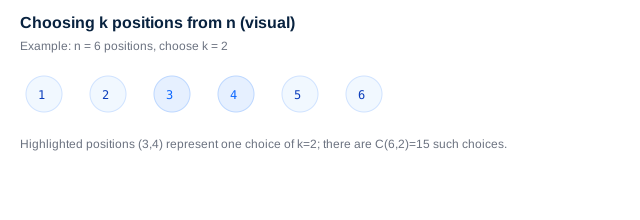
For example, C(4,2) = 6 ways to choose 2 items from 4.
🔺 Pascal's Triangle
Binomial coefficients form a triangular array known as Pascal's Triangle. Each entry is the sum of the two entries directly above it.

How to Read the Triangle
- Row n contains the coefficients for (x+y)n
- The first and last entries are always 1
- Each interior entry equals the sum of the two above it
- The triangle is symmetric
📈 Key Identities
These identities are derived from the binomial theorem and are essential in combinatorics:
Sum of All Coefficients
Σk=0n C(n,k) = 2n
Number of subsets of an n-element set.
Alternating Sum
Σ (−1)k C(n,k) = 0 (n > 0)
Equal numbers of even and odd-sized subsets.
Weighted Sum
Σ k × C(n,k) = n × 2n−1
Expected sum of all subset sizes.
🎲 Binomial Distribution
Binomial coefficients form the basis of the binomial distribution, which models the number of successes in n independent Bernoulli trials.
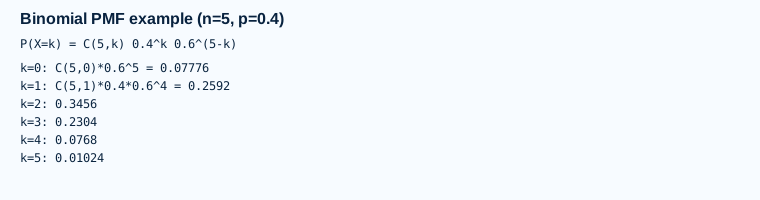
Probability Mass Function
P(X = k) = C(n,k) × pk × (1−p)n−k
Example: P(exactly 3 heads in 5 flips) = C(5,3) × 0.5³ × 0.5² = 10 × 0.125 = 0.125 (12.5%)
📝 Example: (x + y)⁴
Using row 4 of Pascal's triangle: 1, 4, 6, 4, 1
(x + y)⁴ = x⁴ + 4x³y + 6x²y² + 4xy³ + y⁴
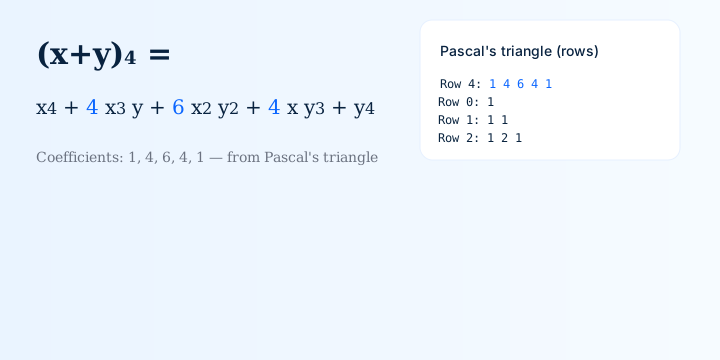
✅ Verification: x=1, y=1 → 1+4+6+4+1 = 16 = 2⁴
💻 Computation Algorithms
Efficient computation of binomial coefficients for large n:
Multiplicative Algorithm (avoids large factorials)
function binomialCoefficient(n, k):
    if k < 0 or k > n: return 0
    if k > n - k: k = n - k
    result = 1
    for i in range(1, k + 1):
        result = result * (n - i + 1) / i
    return result
Generate Pascal's Row
row = [1]
for k in 1..n:
    row[k] = row[k-1] * (n - k + 1) / k
💡 Pro Tips
- Use symmetry: C(n,k) = C(n, n−k)
- Python:
math.comb(n, k)for arbitrary precision - JavaScript: Use
BigIntfor large coefficients