Resources & Downloads
Downloadable SVG assets, LaTeX snippets, reference materials, and external learning resources to help you master the binomial theorem.
📦 Downloadable SVG Assets
All SVG files are vector graphics that can be scaled to any size without quality loss. Perfect for presentations, posters, and educational materials.
📐 Pascal's Triangle
Complete triangle showing rows 0-8 with binomial coefficients.
Download SVG
📈 Binomial Expansion
Visual representation of (x+y)⁴ expansion with all terms.
Download SVG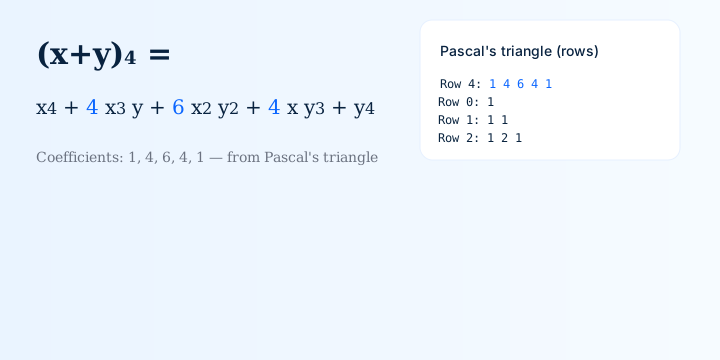
🔢 Combination Diagram
Visual explanation of choosing k items from n.
Download SVG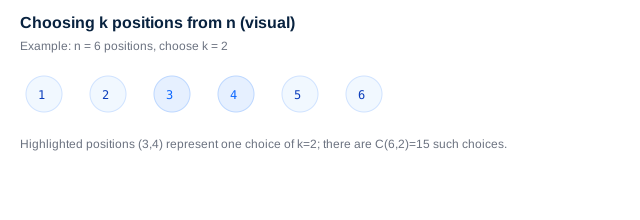
🔄 Induction Steps
Diagram of mathematical induction proof structure.
Download SVG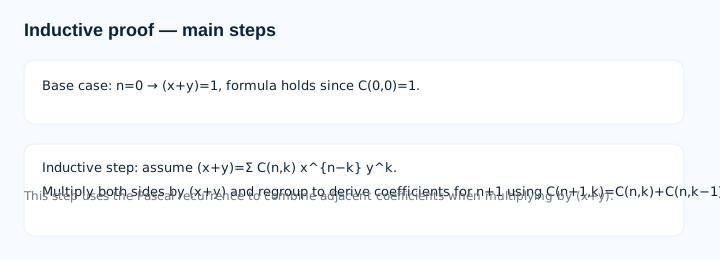
📉 Binomial Distribution
Probability mass function visualization for different n and p.
Download SVG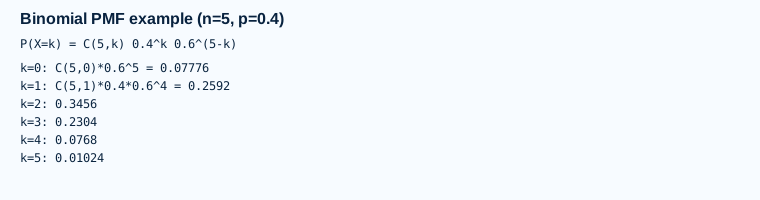
📚 LaTeX Snippets
Copy these LaTeX snippets for use in academic papers, presentations, or typesetting. All snippets are ready to use in Overleaf, TeX editors, or markdown with math support.
% === Binomial Theorem ===
\( (x + y)^n = \sum_{k=0}^{n} \binom{n}{k} x^{n-k} y^k \)

% === Binomial Coefficient ===
\( \binom{n}{k} = \frac{n!}{k!(n-k)!} \)

% === Alternative Notation ===
\( {n \choose k} = \frac{n \cdot (n-1) \cdots (n-k+1)}{k!} \)

% === Pascal's Identity ===
\( \binom{n+1}{k} = \binom{n}{k} + \binom{n}{k-1} \)

% === Vandermonde's Identity ===
\( \sum_{k=0}^{r} \binom{m}{k} \binom{n}{r-k} = \binom{m+n}{r} \)

% === Binomial Distribution PMF ===
\( P(X = k) = \binom{n}{k} p^k (1-p)^{n-k} \)

% === General Binomial Series ===
\( (1 + x)^\alpha = \sum_{k=0}^{\infty} \binom{\alpha}{k} x^k \)
💡 LaTeX Tips
- For inline math, use
\( ... \)or$ ... $ - For display math, use
\[ ... \]or$$ ... $$ - Use
\binom{n}{k}for binomial coefficients (recommended) - For large displays, consider using the
amsmathpackage
📋 Quick Reference Cards
Printable reference cards for study and teaching.
Pascal's Triangle (Rows 0-8)
0: 1
1: 1 1
2: 1 2 1
3: 1 3 3 1
4: 1 4 6 4 1
5: 1 5 10 10 5 1
6: 1 6 15 20 15 6 1
7: 1 7 21 35 35 21 7 1
8: 1 8 28 56 70 56 28 8 1
Key Formulas
C(n,k) = n! / (k!(n−k)!)
C(n,k) = C(n,n−k) [symmetry]
Σ C(n,k) = 2ⁿ
Σ k·C(n,k) = n·2ⁿ⁻¹
Σ (−1)ᵏC(n,k) = 0 (n>0)
Common Values C(n,k)
C(5,0) = 1 | C(5,1) = 5 | C(5,2) = 10
C(5,3) = 10 | C(5,4) = 5 | C(5,5) = 1
C(10,5) = 252
C(20,10) = 184,756
C(n,1) = n | C(n,n−1) = n
📖 External Learning Resources
Recommended textbooks, online courses, and reference materials for deeper study of the binomial theorem and combinatorics.
Textbook References
- Concrete Mathematics (Graham, Knuth, Patashnik)
- Enumerative Combinatorics, Vol. 1 (Richard Stanley)
- A Walk Through Combinatorics (Miklós Bóna)
- Introduction to Probability (Blitzstein & Hwang)
Online Resources
- Wikipedia: Binomial Theorem
- Khan Academy: Algebra II
- 3Blue1Brown: Visual explanations
- Math Stack Exchange: Q&A community
Related Topics
- Multinomial Theorem
- Generating Functions
- Negative Binomial Distribution
- Poisson Approximation
📝 Attribution & Licensing
⚠️ External Content Attribution
When using content from external sources (like Wikipedia), include proper attribution as required by the license (typically CC BY-SA).
Sample Attribution Templates
// For external images from Wikimedia Commons
"Pascal's Triangle" — Image source: Wikimedia Commons,
CC BY-SA 4.0 — https://commons.wikimedia.org/wiki/File:...

// For Wikipedia content
Content adapted from Wikipedia's "Binomial theorem" article,
licensed under CC BY-SA 4.0 — https://en.wikipedia.org/wiki/Binomial_theorem
This Site's License
All original content, code, and SVG assets on this website are available under:
- Content: CC BY-SA 4.0 (Creative Commons Attribution-ShareAlike 4.0)
- Code: MIT License
- Assets: CC BY-SA 4.0